Well, when Julie (@jreulbach) tweeted about posting a blog by Friday, I thought that sounded easy enough, but it is 11pm on Friday night and I don't really thing I have much to say. So I'll go to a structure that often works well for me: #5things
1. Take a survey of my supplies
I need to go through my supplies look at what I have and figure out what things I need to buy prior to the beginning of the year. Everything is still all packed up, so I hesitate to do this because it means unpacking EVERYTHING!
2. Update my syllabi
I'm teaching a class that I haven't taught for a few years, so I really need to update that syllabus, and there are some minor changes I will make to my others. Those little updates should wait until we are back to school though, because I think we are making some school-wide changes that I will want to account for on the syllabi.
3. Big picture lesson plans
I need to make sure I have big picture ideas for the courses I'm teaching this year. I don't need to have every day planned out (although that would be nice), but I need a course map to follow to keep me on pace.
4. Plan integration of statistics standards
I have decided that I'm done leaving statistics until the end of the year. There is plenty we can do with statistics integrated into other units that will help differentiate between the ugly reality of the world and the simplicity of the mathematics we use to describe it. What I mean is that students will see how linearity can be used to describe a system that doesn't actually have the exact same rate of change at every step along the way, but it might be the best option.
5. Write and mail notes to my students
This year in order to boost student relationships, I want to send a note home to each of my future students prior to school starting (actually prior to the open house). I just want to say "Hey, I'm looking forward to having you in class!" I'm hoping that this will also help students I will be having for a second time start with a clean slate.
Well it looks like I better get to work! Well, at least I have a month still :)
-Kathryn
Friday, July 17, 2015

Friday, July 10, 2015
Thoughts about Reflection
I've been working on a task for my students for the beginning of next year, and I'm stuck deciding between two different types of reflection questions for them to complete afterwards. Essentially they will be answering some Talking Points-style questions in their groups. I'm stuck between asking them:
What do you think? Which set of questions will best help me meet the goals of the reflection when paired with my other questions? Should I do a combination of the pairs (one from each), if so which ones should I pick? Are my other reflection questions posed in a way that will help me meet the goals of the reflection?
- Which are you most confident about? Why?
- Which are you least confident about? Why?
OR
- Which was the easiest to make a decision about? Why?
- Which was the most difficult to make a decision about? Why?
While I think it is over-kill to ask all four questions, and it is unlikely that my students would recognize the minor differences between the questions if posed all four, I feel it is likely I would get different responses depending on which questions I pose.
Maybe I'm overthinking it, maybe not. What do you think?
I think my goals from the reflection are:
- To help students see the value in the Talking Points structure
- To help students think about their learning
- To help me see what my students do and do not understand
Other reflection questions I plan to ask:
- How easy or difficult was it to follow the talking points structure?
- What is one benefit you saw to using the talking points structure? One disadvantage?
- What is one thing you learned? What is one question you still have?
-Kathryn
Monday, June 15, 2015
Units and Learning Targets 2014-2015
I often see a tweet from someone who is searching for learning targets for Algebra 1. Two summers ago I worked hard to create learning targets and units based off of the common core standards my district has chosen for Algebra 1. Those are posted on this blog, but I thought it might be valuable to share what I did this year, as it doesn't quite line up with what I shared before (planning and reality rarely align).
Unit 1: Number and Operations
Unit 1: Number and Operations
- I can perform operations with integers.
- I can identify and justify number equivalencies.
- I can order numbers.
Unit 2: Expressions
- I can use the distributive property to rewrite expressions in equivalent forms.
- I can simplify expressions by combining like terms.
- I can evaluate expressions for the given value(s) of the variable(s).
Unit 3: Equations
- I can solve linear equations.
- I can graph linear equations.
- I can solve a multi-variable linear equation for a given variable.
Unit 4: Systems of Equations
- I can state whether or not given values for the variables represent a solution to a system of equations.
- I can estimate a solution to a system graphically.
- I can solve a system using substitution.
- I can solve a system using elimination.
Unit 5: Sequences
- I can determine if a sequence is arithmetic, geometric, or neither.
- I can describe a sequence recursively.
- I can describe a sequence explicitly.
Unit 6: Functions
- I can find the domain and range of a relation.
- I can determine and justify if a relation is a function.
- I can use function notation to describe, evaluate, and graph a function.
Unit 7: Exponentials
- I can simplify and exponential expression.
- I can determine and justify if a function is exponential.
- I can find the base and y-intercept given an exponential function.
- I can graph an exponential function.
Unit 8: Polynomial Operations
- I can identify the degree of a polynomial.
- I can add and subtract polynomials.
- I can multiply polynomials.
- I can factor polynomials.
Unit 9: Quadratic Functions
- I can determine and justify if a function is quadratic.
- I can find the zeros of a quadratic function.
- I can sketch a graph of a quadratic function.
- I can find the line of symmetry and vertex of a quadratic function.
Unit 10: Statistics
- I can organize and analyze bivariate data.
My (Brief) Reflection:
- Units 1 and 2 were boring for many of my students this year, but things I perceived my students the previous year to need. Also things I think many students benefited from. I would like to do some sort of pretest to see which students could benefit from what...but that will be complicated...
- I want to integrate statistics into my other units. It gives a setting to apply the other learning that is "real-world" and then I won't save it until the end and end up not being able to do it.
- I need to focus somewhere on "rate of change" a little bit more...maybe since we didn't really do a linear functions unit this year that struggled.
- I would like to take time to compare these to the original learning targets I planned out and decide which I prefer for which units.
So here they are to borrow, steal, or edit! Enjoy :)
-Kathryn
Saturday, May 16, 2015
#5things To Welcome Next Year's 9th Gradersl
I LOVE meeting my future students! I do a lot of things to help them feel welcomed and to try to provide a smooth transition to high school.
1. Attend Their Math Class
I'm grateful that my principal will hire a 1/2 day sub so that I can attend their math classes one day and give them the Algebra Probe our district uses as a pretest. I get to meet them, talk to them about high school, Algebra, and then assess them on what they can do. All this happens in their 8th grade math class, which they are already comfortable in! Hooray!
2. Attend 8th Grade Parent Meeting
My district holds an 8th grade parent meeting in the spring for parents and students to attend. I attend this meeting too, so I get to see the students and their parents again :) I also work with other core and elective 9th grade teachers to have a supply list available to students and parents that night.
3. Learn Their Names--FAST
I work by tail end off to learn their names as soon as I can. I actually work on this all year. Whenever I encounter 8th graders at school or in the community I ask other people their names and I try to figure out their connections to my current 9th graders. Who is friends with whom...who is siblings with whom...etc. It helps a lot. Then when I go into their math class, I call them all by name and they are SHOCKED. One class this year was so surprised that they asked me to go around the room saying everyone's name, and they clapped when I finished :)
4. Tell Them I'm Excited
I always emphasize with them how excited I am to have them next year. I share my excitement and ask them what they are looking forward to and what they are nervous about. Some students shared about being worried they would embarrass themselves, so I shared something embarrassing I had done before--they all got to laugh at me :)
5. Mail Them a Postcard
OK--I've never actually done this before, but I really want to! I want to send a postcard home to each of my future students this summer. A few weeks before school starts just send them a quick note letting them know that I'm excited for them to come to high school! Then I can add a special note to kids I haven't met, kids who are in my homeroom, or kids I've encountered for other reasons.
-Kathryn
Saturday, May 9, 2015
New Homework Structure
My current homework structure is based off of @iisanumber (Kathryn Belmonte)'s presentation last year at #TMC14. Here is her write up on Math Maintenance. I used it to create a structure for homework for my students. Five problems, every night Monday through Thursday. On Tuesday we discussed Monday night's problems as our warm up. Here is a picture of what a week's worth of homework might look like:

Things that were going well:


Update 8/19/2015: Now by popular demand, here is a folder where I uploaded all of my Math Maintenance assignments from the past year. They are all dated based on last year. I will not use these exact documents this year, but create it to cater to our current learning. Also I didn't start the new structure until the spring, so most are according to the old structure. And finally, these are the electronic versions, sometimes I write on documents before copying out for my students.

Things that were going well:
- spiraling in the review, so things didn't get "old"
- consistent structure
- quick, approachable homework for my students
Things that weren't going so well:
- there was so very clear evidence of copying
- many low students were not completing it regularly
And then, recently at a training by my local Area Education Agency (@ghaea) they shared this document with us: Teaching Strategies For Improving Algebra Knowledge in Middle and High School Students [large PDF]. This is a compilation of research surrounding teaching secondary mathematics by the Institute of Education Sciences. My understanding is that they summarize and compile all the research out there to make conclusions in one place. Making it more accessible to educators who do not have time or resources to find all the research that is out there. Pretty great resource for us to be taking advantage of. Unfortunately, there is not a whole ton of secondary mathematics education research out there, so even the recommendations they make based on the research have only minimal to moderate evidence to support them. Sad day.
Their first recommendation is the one that caused me to change my Math Maintenance. It is: "Use solved problems to engage students in analyzing algebraic reasoning and strategies." This can be done in many ways, one of which is to juxtapose a correctly solved problem with a similar problem for them to complete. This forces students to look at a solved problem, think through the reasoning, and then apply it to a new (but similar) problem.
At our training we were asked to think through ways that we could apply this in our classroom, and math maintenance seemed like a good place to start. Hopefully it will make it more accessible to all learners, while simultaneously making it more rigourous. Here is an example of what it looks like now.


Students who have successfully completed Math Maintenance in the past have been telling me that it is now harder, and I think that is a big win. They went from having to repeat the same thing over and over to having to actually think through what was happening in that type of problem. Students who had problems completing Math Maintenance like to have one that is already completed to look off of. I think that means this is a double win :)
Could you see yourself doing something like this in your classroom?
-Kathryn
Update 8/19/2015: Now by popular demand, here is a folder where I uploaded all of my Math Maintenance assignments from the past year. They are all dated based on last year. I will not use these exact documents this year, but create it to cater to our current learning. Also I didn't start the new structure until the spring, so most are according to the old structure. And finally, these are the electronic versions, sometimes I write on documents before copying out for my students.
Sunday, March 8, 2015
How I Used Plickers
I just started using Plickers in one of my classes. I learned about them at #TMC14, and if you don't know what I'm talking about go here to find out about them.
Note: this is my reflection of my use in the classroom; nothing more
Set-up: I printed the free plickers, size "normal" and copied onto colored paper, laminated, and wrote each student's name on the back in sharpie. I had my students use the plickers for one question on Monday and one question on Tuesday, just to see how they would work. Then I planned to use them multiple times on Wednesday.
Class: I was doing this in my intervention class, which has 8 students enrolled. I wanted to try plickers in my smaller, more flexible class before full-out implementing into my large core classes.
We have been studying domain and range, so I prepared seven graphs, each with 4 options for domain and range, trying to include common errors as possible options. I also created some beginning questions about domain and range, just to get us started.


Implementation: I showed the graphs and the options using my document camera and the students pulled chairs around the screen. I did not show the plickers "Live View" because I was showing everything they needed through the doc camera. I gave them 30 seconds to think then asked them to hold up their answers and I scanned with my iPad.
The app gives immediate feedback as to who was right and who was wrong, and which wrong answer they selected. I can use that to base our follow-up conversation before we move on to the next question.


Reflection Thoughts:
Note: this is my reflection of my use in the classroom; nothing more
Set-up: I printed the free plickers, size "normal" and copied onto colored paper, laminated, and wrote each student's name on the back in sharpie. I had my students use the plickers for one question on Monday and one question on Tuesday, just to see how they would work. Then I planned to use them multiple times on Wednesday.
Class: I was doing this in my intervention class, which has 8 students enrolled. I wanted to try plickers in my smaller, more flexible class before full-out implementing into my large core classes.
We have been studying domain and range, so I prepared seven graphs, each with 4 options for domain and range, trying to include common errors as possible options. I also created some beginning questions about domain and range, just to get us started.
Implementation: I showed the graphs and the options using my document camera and the students pulled chairs around the screen. I did not show the plickers "Live View" because I was showing everything they needed through the doc camera. I gave them 30 seconds to think then asked them to hold up their answers and I scanned with my iPad.
The app gives immediate feedback as to who was right and who was wrong, and which wrong answer they selected. I can use that to base our follow-up conversation before we move on to the next question.
Reflection Thoughts:
- The kids LOVED it. They asked to do it everyday and for the most part they were engaged the whole time.
- At the end of the lesson I gave the a graph and had them give the domain and range WITHOUT options. They were more successful than they would have been before the lesson, but not as successful as I would have hoped.
- The app seems slow, but I have to remember that it is faster than if I had to read and judge them all.
- If they are covering up any part of the QR Code it will not read their answer.
- I'm not ready to implement in a full class, because it would be harder to keep everyone engaged.
- I can't think of a better way to help students learn about domain and range in a way that will engage them and simplify it to make it more accessible to all students from the beginning.
- I'm planning on doing something similar in the future with other concepts.
How have you tried plickers? What did you like? What does it take to make a good plicker lesson?
-Kathryn
Friday, February 13, 2015
Function Notation Slider
After my immensely popular tweet of these pictures:

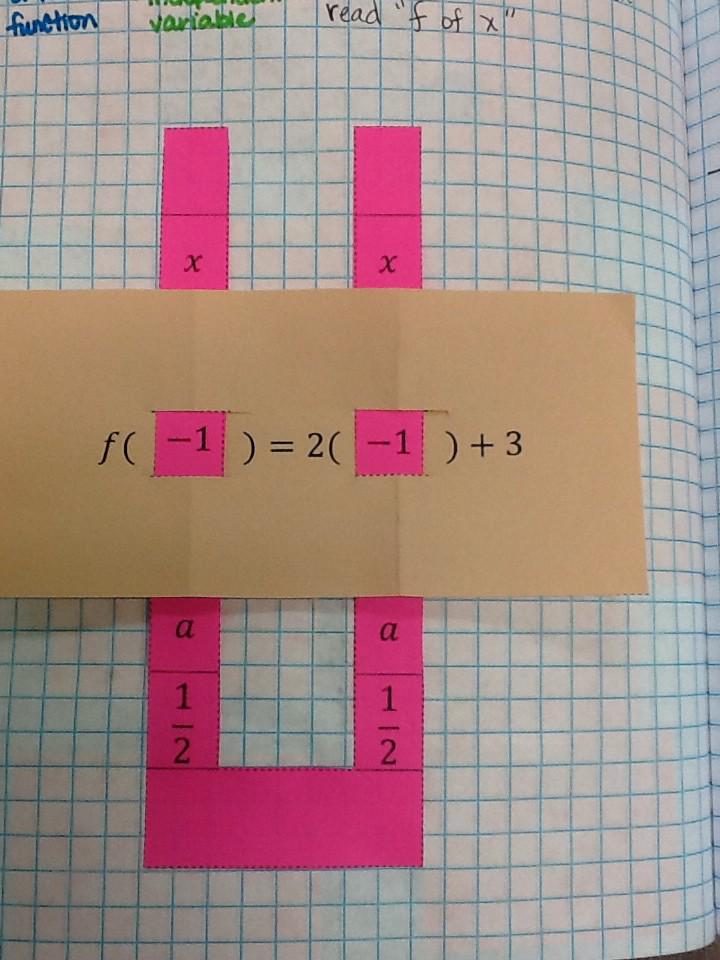
I figured I should blog about what we did for function notation in my class. We made this slider for our notebooks. The files can be found here. They are 3/page and 6/page with dotted lines where you need to cut. You will need to download into word for the files to be formatted correctly. We glued the top and bottom of the pink one down, so that the brown can slide. (Side note: 9th graders might need instruction and assistance with cutting the isolated slits on the brown one.) On the right side of our notebooks we worked through each different input value and simplified as much as we could.
The next day we did a quiz-quiz-trade activity. This helped students gain confidence. After doing four problems quiz-quiz-trade style I gave them one to do individually and went around checking their work. I did a quadratic to make sure they were simplifying exponents BEFORE multiplying. If students didn't have it correct I could give them some quick feedback, they would fix it, and I would check it again.
There's more to what we did (and are still doing), but that's all I feel like blogging about now. Thanks for all the encouragement via my tweet. It was amazing to see the power of twitter in that another teacher (in another country) took the idea and improved it and used it THE VERY NEXT DAY! My students all think I'm a super-star now and they are impressed that I had one idea of my own. It reminded me of what a blessing it is to be part of the #MTBoS!
-Kathryn
Subscribe to:
Posts (Atom)