Sunday, March 8, 2015

How I Used Plickers

I just started using Plickers in one of my classes.  I learned about them at #TMC14, and if you don't know what I'm talking about go here to find out about them.

Note:  this is my reflection of my use in the classroom; nothing more

Set-up:  I printed the free plickers, size "normal" and copied onto colored paper, laminated, and wrote each student's name on the back in sharpie.  I had my students use the plickers for one question on Monday and one question on Tuesday, just to see how they would work.  Then I planned to use them multiple times on Wednesday.

Class:  I was doing this in my intervention class, which has 8 students enrolled.  I wanted to try plickers in my smaller, more flexible class before full-out implementing into my large core classes.

We have been studying domain and range, so I prepared seven graphs, each with 4 options for domain and range, trying to include common errors as possible options.  I also created some beginning questions about domain and range, just to get us started.


Implementation:  I showed the graphs and the options using my document camera and the students pulled chairs around the screen.  I did not show the plickers "Live View" because I was showing everything they needed through the doc camera.  I gave them 30 seconds to think then asked them to hold up their answers and I scanned with my iPad.

The app gives immediate feedback as to who was right and who was wrong, and which wrong answer they selected.  I can use that to base our follow-up conversation before we move on to the next question.


Reflection Thoughts:

  • The kids LOVED it.  They asked to do it everyday and for the most part they were engaged the whole time.
  • At the end of the lesson I gave the a graph and had them give the domain and range WITHOUT options.  They were more successful than they would have been before the lesson, but not as successful as I would have hoped.
  • The app seems slow, but I have to remember that it is faster than if I had to read and judge them all.
  • If they are covering up any part of the QR Code it will not read their answer.
  • I'm not ready to implement in a full class, because it would be harder to keep everyone engaged.
  • I can't think of a better way to help students learn about domain and range in a way that will engage them and simplify it to make it more accessible to all students from the beginning.
  • I'm planning on doing something similar in the future with other concepts.
How have you tried plickers?  What did you like?  What does it take to make a good plicker lesson?

-Kathryn

Friday, February 13, 2015

Function Notation Slider

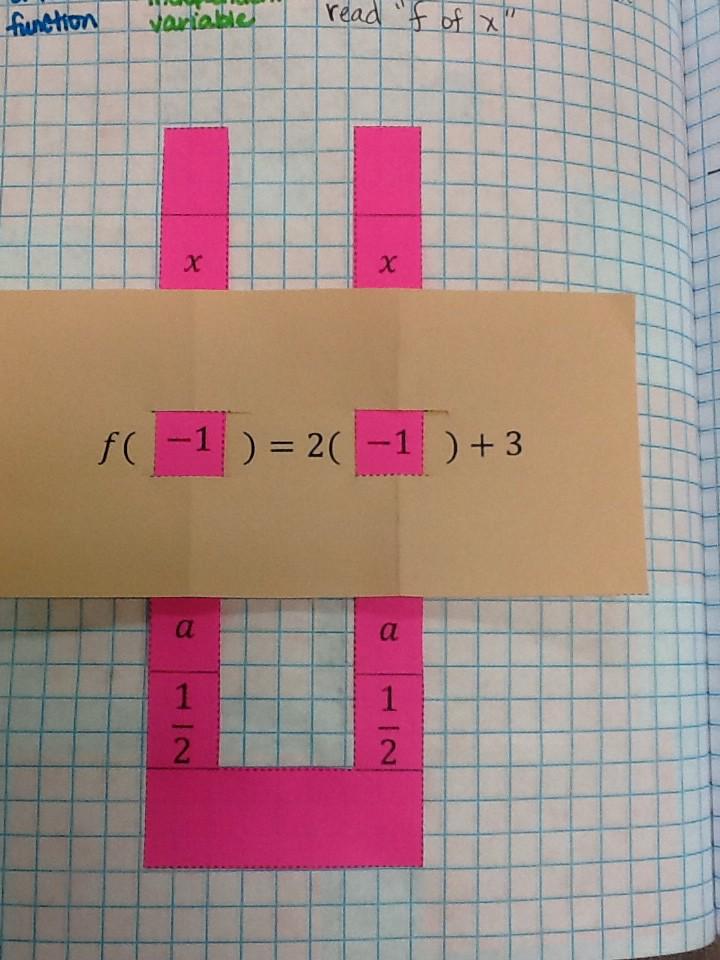
After my immensely popular tweet of these pictures:

Embedded image permalinkEmbedded image permalink


I figured I should blog about what we did for function notation in my class.  We made this slider for our notebooks.  The files can be found here.  They are 3/page and 6/page with dotted lines where you need to cut.  You will need to download into word for the files to be formatted correctly.  We glued the top and bottom of the pink one down, so that the brown can slide.  (Side note:  9th graders might need instruction and assistance with cutting the isolated slits on the brown one.)  On the right side of our notebooks we worked through each different input value and simplified as much as we could.

The next day we did a quiz-quiz-trade activity.  This helped students gain confidence.  After doing four problems quiz-quiz-trade style I gave them one to do individually and went around checking their work.  I did a quadratic to make sure they were simplifying exponents BEFORE multiplying.  If students didn't have it correct I could give them some quick feedback, they would fix it, and I would check it again.

There's more to what we did (and are still doing), but that's all I feel like blogging about now.  Thanks for all the encouragement via my tweet.  It was amazing to see the power of twitter in that another teacher (in another country) took the idea and improved it and used it THE VERY NEXT DAY!  My students all think I'm a super-star now and they are impressed that I had one idea of my own.  It reminded me of what a blessing it is to be part of the #MTBoS!

-Kathryn


Saturday, January 31, 2015

New Steps I'm Taking to Improve Group Work

I'm working a lot harder on making group work work in my classroom this semester.  I implemented some changes first semester, and expected it to work for itself from there...uh, duh Kathryn, you can't just put things in place and expect them to run themselves.  So I've been more thoughtful about it this semester, and trying to patiently look for small improvements.  Since I rarely blog, I will discuss all changes I have made this year.

First Semester

Desks in Groups of 4:  I have tables, so I've pushed two together to make groups of four.  I had this on and off last year, but I haven't even considered changing it once this year.


Group Supply Tubs:  I organized supplies into group tubs.  Something I sort of had last year, but that didn't work very well.  I also was intentional about not putting too much stuff in at the beginning of the year.


Roles:  I wrote about my role cards before school started, but I expected a little prep and some pretty cards to be enough for students to "play their role" every time...that is not enough.

Talking Points:  We do talking points as a warm-up every Thursday.  This helps give every student a voice.

Then I'd also throw around the phrase "do this in your groups" a lot and feel frustrated that they really weren't.  So I have tried to be more thoughtful.

Second Semester

Role Explanations in Notebook:  I made a half-sheet explanation of all the roles for students to put into their ISNs.  This way they ALWAYS had access to them and I could hold them more accountable.


Group Tasks:  I have been a lot more intentional about groups tasks.  One scored group task every unit is my challenge for myself.  This is super structured, and involves a significant amount of prep.  An important thing I learned from Elizabeth and our morning session at #TMC14 is to put in checkpoints for groups to call me over and see how they are progressing.  This helps a lot.  I even carry around a roster so that I can mark off what checkpoint each student has completed.  Then when I'm prepping for day 2 of the task, I have an idea of where everyone is and who I should maybe guide right from the beginning.

At this point I haven't done any amazingly exploratory/discovery task, but I think that's OK.  I'm not super-teacher, so small steps is what it is going to take.  I've turned some things I did last year (that I liked) into tasks that I now like better.  I'm sure they will morph next year into things I like even better...oh the joys of teaching!

Here is my sequence task:  Instructions, Cut Outs

Here is my function task:  Instructions, Cut Outs, Recording Sheet

Acknowledging What I Like:  I've been intentionally looking for things that I like during the group work time so that I can praise those things.  This helps me and my students, because I see the good things rather than the bad, and they feel encouraged.  It also leads to improvement because others see what I like from a group and they can work to do it in their group.

I actually just had a thought while I was blogging this that I'm going to try Monday.  I'm going to use my whiteboard to give these acknowledgements.  It is semi-public in that the entire class can see (but not other classes), but I don't have to spend the last couple minutes of class giving shout outs that they might forget by the next day.  AND other groups can IMMEDIATELY implement changes to get acknowledged as well.  I could even start with a few things on the board that I'm looking for and then write up the table number when I see that group doing it.

Group Reflections:  Every day we do any group work task work, I have them complete a quick reflection.  I'm sure I stole the questions from Elizabeth (bottom of this post) and just modified it a bit. It's just a quarter sheet, so I make a ton of copies and have them ready.  My hope is that by regularly trying to give a compliment to someone for playing their role they will become more familiar with the responsibilities of each role.  I might modify the reflection next task to involve something the individual did as well as something another person did.  Try to slowly increase the expectation that EVERYONE is playing their role.

Here is a link to what I've been giving (4 to a page).  And here is what I created for next time (2 to a page).

That's where I'm at with group work right now.  I'm proud of the changes I've made, but also disappointed that we're not farther along.  I have been realizing this year how long real change takes.  And it is a little disheartening because I'm starting to understand that it's going to take more than just me to make real change for our students.  We really need every teacher on board to make real change for students.

Let me know if you see something big (or small) that I'm missing that would make group work more valuable for my students.  I know that it is not ideal at this point, but I'm working on getting better.

-Kathryn

Sunday, September 7, 2014

Talking Points in my Classroom

After my Group Work Working Group morning session, I knew for sure that I wanted to try Talking Points in my classroom.  After a lengthy twitter conversation I was convinced that I didn't need to do it day 1, but that day 2 or day 3 was okay.  We ended up starting with talking points on day 3.

Here are the instructions I gave to my students:
I basically took what Elizabeth shared here (see printable student instruction sheet), and modified it to be only one side.  If you would like my file it is available here (titled structure overview).

We read through this as a class and then I passed out talking about talking and started my timer.  As I walked around I tried to remember that I should NOT be intervening unless they were having trouble with the structure.  Here were my observations:

  • I did not observe any group ALL DAY doing 3 rounds per statement
  • Most groups did not do rounds
  • Many did first round without becauses and then went back and said why after hearing from everyone
  • Many were not taking turns
  • Many students took more than one "turn" per "round" (not really turns or rounds the way students were doing it)
  • Saw dialogue between two students while two were silent (groups of 4)
I pretty much felt like a failure.  I'm really not sure why it my students could get the structure from the handout, but I had to do a lot of intervening.  I tried to wait until the end of a round to really get insight into what the group was doing in order to push them the right direction.  I looked for things groups were doing correctly, too.  And all the way at the end of talking points I shared with the whole class the good things I saw each group doing.  (ie. "I saw table 4 reading the statement out loud.  Thanks table 4!")

I had a thought or two about never doing talking points again, but instead I knew I just needed to push it harder and help students focus better.  I came back the next day ready for more talking points and a little more prepared for how to support my students.  I gave the whole class one structural issue to focus on:  say your becauses, and then went around looking for that as well as the other things.  The next time we did talking points I focused on take turns in rounds.  Then finally three rounds per talking point.  Each time I reminded them of the previous expectations, but added one new thing.  This worked really well for me to focus on the good things that students were doing.

We have done talking points four times now, and my students are starting to get it figured out.  I still have some things to work on with them such as:
  • some groups were doing all statements round 1, then all statements round 2, then all statements round 3
  • most students do not interact much with each others thoughts unless they are "commenting"
  • still see "popcorn" conversation rather than turns dictated by rounds
  • a few groups think round 2 can go as long as they want, giving each student more than 1 turn in round 2
  • Sometimes I hear a student asking "Do you still think ____?" which I do not like
  • A few groups are still not tallying responses during round 3...I'm not exactly sure if they're just writing down their opinion, or if they are voting
So far I have done talking about talking, talking about listening, talking about questions, and talking about roles.  I have mine formatted a little differently than Elizabeth, just because my brain works differently than hers :)  I also always copy the self assessment to the back side and have groups do that together.

All of my files are in a google folder that you can access here.  If you download the file it will open in word.  Also there are many shared talking points available here.

Did anyone else experience my struggle with talking points?  If so, what have you done?  If not, how did you set your students up for success?

-Kathryn

Monday, August 18, 2014

Group Work Role Cards

Happy Monday!  This might be one of my favorite #Made4Math Monday posts (of mine).  I've very excited to share it with you :)

Made4Math

I've been reading Strength in Numbers by Ilana Horn and it talks about complex instruction throughout the book.  I think these roles are based off of a complex instruction structure.  However, I've modified them some on my own and a lot in regards to Elizabeth's post here.  For the most part I stole Elizabeth's changes and them made a few small changes for myself.

Here are my cards:


I laminated them and put them as a set on a ring so that I can store them in the group storage totes.  That way they are accessible to students whenever they need them.


I really like that they will be able to keep instructions for their role in front of them as the work in their groups.  This will help remind them of their duties as well as encourage them to speak out to fulfill their obligations in whatever role they are in.

This is the first time I'm going to try group roles, and I'm pretty nervous!  But these pretty things make me a little less nervous and a little more excited :)  Let me know if you have any tips!

Here is a link to the file I used.  It has one role description per page, 6 times.  Then the last two pages are the role titles written larger, as you see on the "front" of the cards.  (Note:  the file will open in google drive, but you can download it to word if you would like.)

Thanks for reading and thanks for all the encouragement from those of you who saw the picture on twitter!
-Kathryn

Sunday, August 17, 2014

Talking Points with my Family

I've been thinking a lot about talking points since #TMC14 and our #gwwg14 morning session.  Somehow I started wondering about what it would look like it a family setting.  So, I decided to try it!  It was a little like pulling teeth to get my 12-year-old on board today, but with him, myself,  and my husband we made a good group of 3 to try it out.

We started by going through the instructions and then started with "talking about talking".  Here are some of my observations:
  • My 12-year-old's "becauses" were generally restatements of the statement
  • My husband and I tended to agree
  • Rarely did anyone change his/her mind
  • We made it through about as many as I did with my peers at TMC
  • I really wanted to convince them to think like me
  • The 10 minutes went fast and everyone seemed willing to try more in about a week...even wanting to work on the same page
  • We only came to a full consensus on one talking point
I'm trying to not evaluate these observations at this time, but I am trying to get rid of my attitude about wanting to change other peoples minds/attitudes.  If they are willing to try again, then I guess we will just see where this takes us.

-Kathryn

Saturday, August 16, 2014

[Unit Overview] Polynomials

This is very old and thus is going to be mostly pictures since I already have them updated :)

Finding the Degree and Naming Polynomials:


We actually filled this in as much as we could and discussed why we couldn't really have a constant trinomial...

Adding and Subtracting Polynomials:  I wrote up some notes and passed around papers to groups so that they could put what they wanted into their notebooks.  There were also some practice problems and answers.


Then here is what my notebook pages looked like:


Multiplying Polynomials:  I demonstrated two methods for them to choose from.

This is my go-to style for practice problems


Factoring Polynomials:  We defined factor of a trinomial and did a few examples.  Prior to the examples we completed an exploration activity with multiplying polynomials finding b and c and then making observations.  I've done it twice now and it's pretty structured, but I think it's better than me just stating the pattern for them.


Well, that's my quick post that should have been completed in March or April :)  Enjoy!
-Kathryn