The other day I was working on substitution with my students and I wanted them to try three problems that were similar to what we had been working on, but one had no solution, one had infinite solutions, and one had one solution. They had seen these ideas when solving graphically and numerically, but this was the first time with substitution.
Thinking back at the end of the day, I realized that although I had taught the same lesson three times, I had made slight adjustments each period. I thought it was interesting, so I wanted to summarize it here.
In my 4th period, my first Algebra 1 class of the day, I only have 14 students and generally 2-3 of them are absent. So I split the students into 3 groups and had each group focus on one question. Then after 5 minutes, I had each group share out with the class. I think it might have been a little better if I had made the groups jigsaw to share at the end, but I guess I'll save that idea for next time.
In 5th period there are 22 students. Some of the students are very quick learners, others are slow learners, and others are "I don't want to learn" learners. So I gave them some time to work independently or in partners on the three problems, then I went over each one with the class.
In 6th period there are 18 students who are generally slow learners and easily distracted. They are all capable, but not very many of them are used to seeing success in the classroom. I decided for some reason (this was not pre-planned) to get three students to each be a "professional" on one of the problems. I focused my attention getting them on the right track, and then encouraged the other students to ask them for help. After 10 minutes or so, the three students presented their solutions to the class.
I can't say that I preferred one method over the other, but I'm going to side note on one of my classes now...
I have struggled a lot to keep the students focused on learning this semester, but this past week was the best yet. The day about included.
I had begun to realize these students are all very dependent on me as the source of information, processes, and answers. A few of them like to work together, but they tend to get off task and lead each other astray when problem solving. I need to get them to think, problem solve, discuss, justify, share, and ask questions.
I think in order for them to do this they need more of an opportunity to be in charge, so I am going to continue to try to provide that for them little bits at a time. Including by having students present the solutions to bellwork...why did I never think of this before? That was a student-suggested thing we tried this week that worked really well. I think we will continue with it this week...
-Kathryn
Sunday, March 2, 2014

Sunday, February 23, 2014
Setting up Systems of Equations
As I was desperately searching (for a while) for something to boost my systems of equations unit with, I came across this post by Mimi at I Hope This Old Train Breaks Down. It proved to be a great resource. Please check it out!
Things I liked about it:


Things I liked about it:
- There was more than one way to "solve" each puzzle
- The scaffolding was wonderful! Puzzle 1 and 2 were similar, puzzle 3 and 4 were similar, and puzzle 5 and 6 were similar
- The questioning at the end of puzzle 1 would help students more easily solve puzzle 2 (etc.)
- Shapes are much more friendly than x, y, and z. Students were solving systems without knowing it
Because of all that I didn't want to just give my students the giant (8 page?) packet and have them work alone, so I made some formatting changes before using with my students:
- I put each puzzle 4/page
- I typed the questions up on powerpoint
- I printed each puzzle on a different color of paper
So in class it looked a little like this:
- We set up a bit of speed-dating scenario so they could rotate partners
- I passed out Puzzle 1 to all students
- If they completed it they were asked to answer the projected question on the back
- After 5-10 minutes I asked students to share out how they found the solution (I made sure to call on many students each time for various perspectives.)
- We rotated partners
- I passed out Puzzle 2
- Etc.
Here is what it looked like as a quarter piece of paper. After we were all finished I did have students staple all six together and keep them in their pocket for this section. As we got into solving systems using substitution and elimination we kept coming back to this idea of the shape puzzle.
Some things I ran into as we worked:
- Students were using guess-and-check to find their solution. Some kids have super-awesome number sense and could do this easily, but were then not being stretched to think about substitution or elimination.
- Students really struggled to explain clearly their solution method
- In Puzzle 3, some really struggled with that conceptual elimination that needed to happen. I drew it out to help, but that wasn't enough for everyone. Here is something similar to what I had on the board
My files:
Note: The link will open in drive. You will want to download to see the full version in word.
Overall, I LOVED this as an introduction to systems of equations. I'm not sure that I will change much about it when I do it next year. And I have seen it benefiting students as we continue to work on solving systems of equations.
-Kathryn
Tuesday, February 4, 2014
Homework, Oh Homework
(Note #1: The title of this post is inspired by this poem by Jack Prelutsky my sister had to memorize in second grade)
(Note #2: This is my fiftieth post and it is coming exactly one year after I started blogging :)
Homework is a big deal. It is something I have a lot of thoughts about. It is also something I have trouble organizing in my head...so this may be an unorganized post :)
I give almost no homework. Rarely (like maybe twice this year) I have asked a specific period to complete ONE thing outside of class. Also once this year I gave all students a "project". I gave lots of class time, but it may have been necessary to do work outside of class as well.
I am often asked why I don't assign homework. Actually I was recently asked, "How can you not assign homework in math class?" My answer to this question is multi-dimensional.
What is the Purpose?
(Man, this issue is so complicated. I have put it off for a year, and I'm considering just deleting this post right now...)
I guess this right here is the critical issue. All the other stuff doesn't matter. What is the purpose of homework? Traditionally, homework in mathematics was used as additional practice. I prefer to do practice in class so that:
Who Will Do It?
When I first started in my district, I assigned maybe 5 additional problems a night. Maybe 10% of my students completed them. MAYBE. Which students were they? The students who did not need additional practice. The students who needed more practice chose not to do it.
How Will It Get Done?
Previously, in a different district, I assigned homework almost nightly. Ranging closer to 10 to 15 problems a night. I would say my completion rate was closer to 80% there, but by completion I mean students who had the work written out on their own paper by the time class came. What was happening right before school? Massive copying sessions in the halls.
I do not want to put my students in a situation where they are going to want to copy. I want them to see the value in what they are doing (one reason why I think they copy) and I want them to believe that they are capable of doing it themselves (another reason why I think they copy).
What is the Consequence?
If students choose not to complete homework, what is an appropriate consequence? I firmly believe that it should not affect their grade directly. That is something I am not willing to compromise on. So what other options do I have? Without an entire school-wise system, the only option I can think of is to assign a detention. What happens then? I spend extra time (and a lot of if) for several days tracking down students who need to serve a detention to get their work done. And what if they refuse to serve it?
Do They Have Time?
I am so grateful for all of the time that I get to spend with my students. I see them and interact with them for 51 minutes each school day. I think that is more than what some parents get to spend with their children. High school students can get so involved. I think some of them stretch themselves too thinly, but I do think it is good for them to be involved. So if I get more time with my students than their parents, who I am to take away some of the time they might actually get?
Societal Views
Initially I wanted to tackle some of the views society has about homework (including the one exhibited by the poem linked at the beginning of the post), but I'm too worn out right now. Perhaps another time.
Please feel free to comment away. I would be happy to hear both your agreements and disagreements.
-Kathryn
(Note #2: This is my fiftieth post and it is coming exactly one year after I started blogging :)
Homework is a big deal. It is something I have a lot of thoughts about. It is also something I have trouble organizing in my head...so this may be an unorganized post :)
I give almost no homework. Rarely (like maybe twice this year) I have asked a specific period to complete ONE thing outside of class. Also once this year I gave all students a "project". I gave lots of class time, but it may have been necessary to do work outside of class as well.
I am often asked why I don't assign homework. Actually I was recently asked, "How can you not assign homework in math class?" My answer to this question is multi-dimensional.
What is the Purpose?
(Man, this issue is so complicated. I have put it off for a year, and I'm considering just deleting this post right now...)
I guess this right here is the critical issue. All the other stuff doesn't matter. What is the purpose of homework? Traditionally, homework in mathematics was used as additional practice. I prefer to do practice in class so that:
- I can ensure it is getting done
- I can ensure students are doing their own work
- I can ensure it is getting done correctly
- I can question and guide when necessary
- Students can have conversations about what they are learning
So I'm going to discuss the other issues as well, but I do think this is the biggest. What do you see the as the purpose of homework? (Please leave comments, because I truly am curious.)
Who Will Do It?
When I first started in my district, I assigned maybe 5 additional problems a night. Maybe 10% of my students completed them. MAYBE. Which students were they? The students who did not need additional practice. The students who needed more practice chose not to do it.
How Will It Get Done?
Previously, in a different district, I assigned homework almost nightly. Ranging closer to 10 to 15 problems a night. I would say my completion rate was closer to 80% there, but by completion I mean students who had the work written out on their own paper by the time class came. What was happening right before school? Massive copying sessions in the halls.
I do not want to put my students in a situation where they are going to want to copy. I want them to see the value in what they are doing (one reason why I think they copy) and I want them to believe that they are capable of doing it themselves (another reason why I think they copy).
What is the Consequence?
If students choose not to complete homework, what is an appropriate consequence? I firmly believe that it should not affect their grade directly. That is something I am not willing to compromise on. So what other options do I have? Without an entire school-wise system, the only option I can think of is to assign a detention. What happens then? I spend extra time (and a lot of if) for several days tracking down students who need to serve a detention to get their work done. And what if they refuse to serve it?
Do They Have Time?
I am so grateful for all of the time that I get to spend with my students. I see them and interact with them for 51 minutes each school day. I think that is more than what some parents get to spend with their children. High school students can get so involved. I think some of them stretch themselves too thinly, but I do think it is good for them to be involved. So if I get more time with my students than their parents, who I am to take away some of the time they might actually get?
Societal Views
Initially I wanted to tackle some of the views society has about homework (including the one exhibited by the poem linked at the beginning of the post), but I'm too worn out right now. Perhaps another time.
Please feel free to comment away. I would be happy to hear both your agreements and disagreements.
-Kathryn
Saturday, February 1, 2014
Coteaching--For Real!
At semester, when schedules were rearranged, I got a new opportunity. We fiddled with a few things so that a special education teacher and I would be able to coteach an intervention class. She has been involved in our project with the AEA, and as we were continuing to have conversations about how to help the students, it became evident that this was something we both thought would be good for the students.
It has allowed me to serve more students during the intervention time than I did previously; and with less stress. We arranged it so that some of our lowest students are in the intervention class together. We have 12 students and 2 teachers. It is such an awesome opportunity for me (as a gen ed teacher) to have so few students at a time!
We had some conversation about how best to coteach, because it is not very common in our school or even in our area of the state. But this teacher is also a reading teacher, so we thought it would work well to have her do vocabulary and then I can work on the content for each of our weekly units. Here is a breakdown of what our week looks like:
THURSDAY:
- Opening Task: fluency practice
- Vocabulary (as a class we make flashcards for our vocabulary words for the week)
- Very simple intro to the content
FRIDAY
- Opening Task: counting circle
- Split Class: Vocab and Content then switch so all students get both
- Finish content work
- Exit Ticket
MONDAY
- Opening Task: counting circle
- Split Class: Vocab and Content then switch so all students get both
- Finish content work
- Exit Ticket
TUESDAY
- Opening Task: fluency practice
- Split Class: Vocab and Content then switch so all students get both
- Finish content work
- Exit Ticket
WEDNESDAY
- Opening Task: counting circle
- Vocab and Content assessment
- (every other week we progress monitor)
Most of the ideas for how to structure this came from the project with the AEA. We just manipulated it to fit our situation best. Let me know what you like or what you would change if it was you!
-Kathryn
Sunday, January 19, 2014
Sequences
We wrapped up second semester with a unit on sequences. I like doing sequences after studying linear and exponential functions because I feel it gives an opportunity to compare and contrast linear and exponential situation. And when we first distinguish between arithmetic and geometric sequences, students are fairly quick to make the connection to linear and exponential functions. (yay!)
Before we even do anything officially sequence related, I usually give my students four sequences (one adding, one subtracting, one multiplying, and one dividing). I give the first four terms and ask them to find the pattern, the starting point, and the next three terms. This gives them a little time to transition to new material that appears easy.
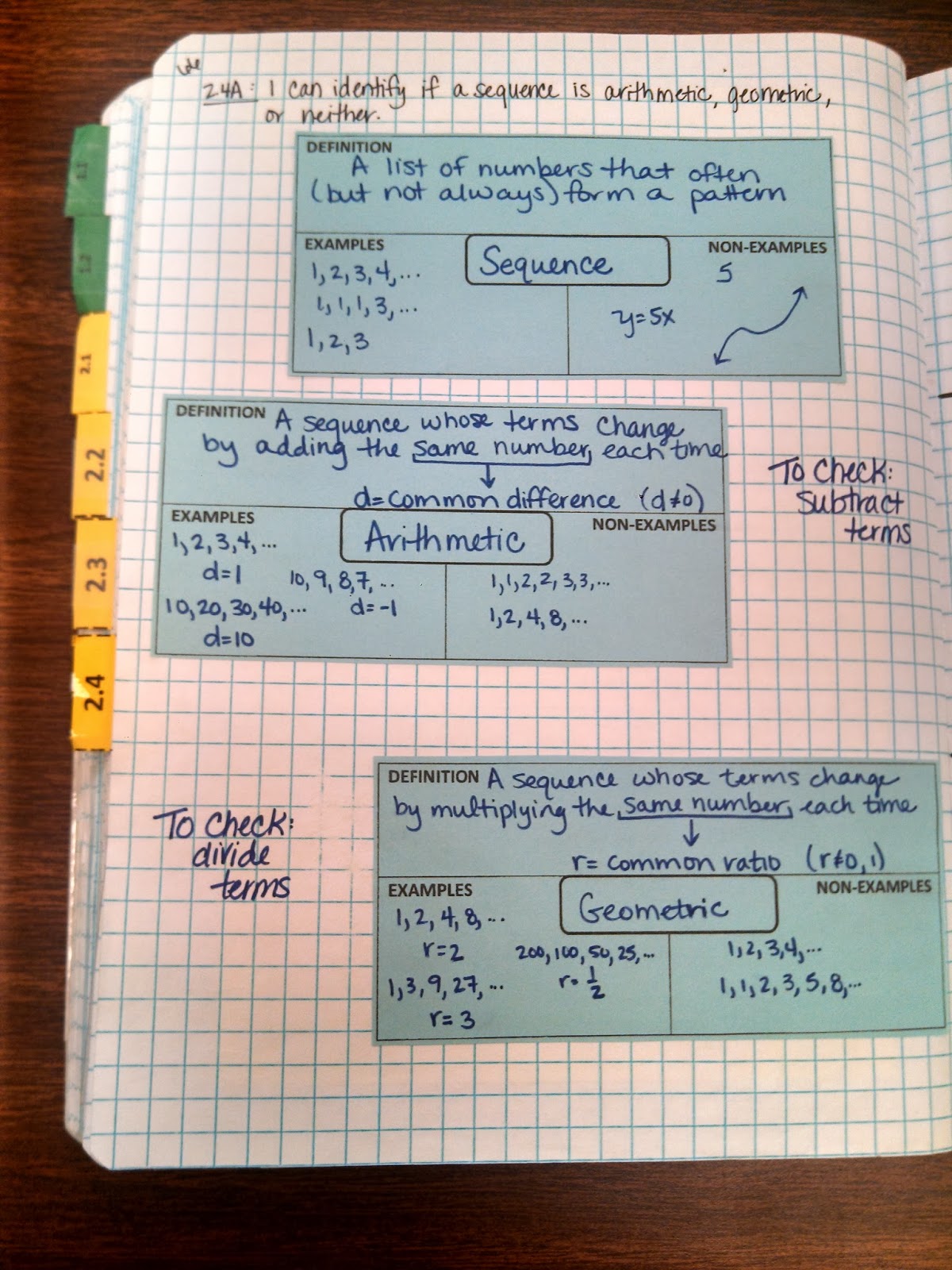
This time we tried a table of contents. (Which I got from Sarah at math=love. You can find it here.) I liked it a lot because I used it to makes students think (just a little) about what was on each page.
Definitions of sequence, arithmetic, and geometric. I wanted to be good about including vocabulary, but I still don't think this was enough. I needed to also show how the words were related to each other, perhaps a graphic organizer was in order...
I displayed a bunch of sequences using my projector and had students sort them on the right side of their notebook to practice their understanding of the definitions. Also to show that it isn't always easy to tell...sometimes they will need to subtract and divide to check.
Some students wanted to label this page arithmetic, geometric, and sequence...that was a little concerning and shows that I did indeed need to more emphasize the relationship between the words I was teaching.

Notes:
Before we even do anything officially sequence related, I usually give my students four sequences (one adding, one subtracting, one multiplying, and one dividing). I give the first four terms and ask them to find the pattern, the starting point, and the next three terms. This gives them a little time to transition to new material that appears easy.
This time we tried a table of contents. (Which I got from Sarah at math=love. You can find it here.) I liked it a lot because I used it to makes students think (just a little) about what was on each page.
 |
| Table of Contents |
 |
| Definitions |
 |
| Sort these |
Next we discussed writing formulas for the sequences. Since I had asked about starting point and pattern as we went, I thought recursive was a natural follow. Instead of using all the nasty notation (a_n, a_1, etc.), I talked with my area education association and someone recommended this now = /next = notation.
Note: I liked it a lot, but students wanted to just put the "now" in for the "now" in the second equation so that there would only be one equation. I think it might have been better to use start = /next = now/. That might help.
 |
| Notes on recursive formulas |
To practice I displayed a bunch of sequences and asked students to write the recursive formula for 8 of the 12.
 |
| Practice Problems to be displayed |
 |
| My notebook had the answers :) |
Next we looked at writing formulas explicitly. I tied this into the equations for linear and exponential functions. We did a mini-breakdown of the equations in class and came up with:
- Arithmetic: a = d*n + start
- Geometric: a = start*r^n
Those would be very familiar to them and still used a little bit of "sequence notation".
 |
| Notes on explicit formulas |
We practiced writing explicit formulas the same way we did recursive (even with the same exact sequences).
 |
| My notebook :) |
My last learning target for this unit is "I can explain why a sequence is a function." It is perhaps a not-so-great learning target because it is somewhat difficult to teach and assess in a way that requires student thinking and learning. However, it is very closely aligned to a standard (F.IF.3...?) and I struggle with the battle between whether I should be assessing standards or learning targets. Anyway those thoughts are best left for a different post.
Here is what we did. It was an investigation of sorts, where students were to choose a sequence and determine if the table that represented it was a function and if the graph that represented it was a function. However we had difficulties because my students didn't do super well with determining if something is a function.
The goal was that students would choose a wide-variety of functions and we could whiteboard individual results, do a gallery walk, and come to the conclusion that all sequences were functions. However it didn't go down quite like that. I perhaps needed another day of class, but it was crunch time for semester tests, so I didn't have any wiggle room.
I ended up having a class discussion, but not assessing that standard. It is what it is I suppose.
 |
| Sequence = Function (p.1) |
 |
| Sequence = Function (p. 2) |
- I wish I had done more vocabulary up front (ie. term, first term, second term, common difference, common ratio). It is hard for me to remember what words are new to students.
- Also a graphic organizer to show the relationship between sequence, arithmetic, and geometric.
- As I said, with recursive formula, I would change the first equation from now = ___ to start = ___.
- I've really been thinking about how I need to spiral some review in for students. (More on this later...probably not until this summer.) I believe this would have helped as we looked at sequences as functions.
Please leave any thoughts or suggestions in the comments, or tweet me (@kathrynfreed).
-Kathryn
Sunday, January 12, 2014
Solving One-Variable Linear Equations
Confession: I taught an entire semester of Algebra 1 without spending time solving linear equations.
Why? Because I knew my students had seen a lot of it in 8th grade, and I also knew that they were all at different places and ready for different challenges. I also knew that they had forgotten some of what they had learned and a little reminder might take them a lot further. All of this is hard to address in a class of 20+ students.
However, I knew it was something I needed to address at the start of this semester so that we could solve systems and eventually some quadratics. I gave a pretest, but it was evident that not a lot was immediately recall-able for them. So I spent a few days focusing on solving 2-step equations. Here are a few reasons why I chose to start with 2-step equations:
- I can say they can all be solved in 2-steps, which helps the students process what they need to do
- I can address issues like "Ah, there's a fraction!" (but it really just means division) and I can even throw in some parenthesis
- I can challenge all students with things like -t + 10.2 = -23.1 (the negative variable is really tricky the first few times they see it)
- It is not out of the reach of most students (I do have a few students who still struggle to solve one-step...but those are students who did not take 8th grade math in my district last year.)
- It is enough to bring back a lot of what they learned about solving equations
I have one Algebra class that is a little bit quicker than the others, so I got to move away from 2-step equations with them on Friday. I couldn't decide exactly how to do it, because there are SO MANY ways to solve different equations. I really just want to ensure they are aware of the various options they have and give them some practice at choosing what to use in what scenarios. I don't want to say: "always distribute" or "put the variable terms on the left and the constants on the right" or anything that shows that there is only one way to solve. I want problem solvers, not procedure followers.
Anyway, here is what I ended up doing. I just gave them 4 "challenge" equations to solve. And for the most part, they worked HARD for 30 minutes to work out solutions. Here are the equations:
- 2(-1x + 6) = 22
- 2x + 2 = 32 + 5x
- 3 - 2x + 6x = 15
- 5x - 7 = 2(x + 1)
I put the four equations on the board and said "I challenge you to use the resources available in this room to find the solutions (and perhaps a solution method) to these equations today." We discussed what resources were available and then they got to work. The review we had done with 2-steps was enough for several students to remember even how to move variable terms to the other side.
There were a few students who "tried" and then gave up and didn't accomplish much at all, but I would say at least 85% of my students worked hard during the time I gave them. I was SO PROUD of them. I just wanted to brag a little about my students, because it was everything I hoped it would be.
We will continue to work with advanced linear equations on Monday and Tuesday to get them more fluent at being aware of the strategies that are available and choosing an appropriate one. Perhaps with some whiteboarding...
-Kathryn
Thursday, January 9, 2014
Quizlet
I need to get back onto the blogging wagon, and I have been trying unsuccessfully. So instead of blogging about something thoughtful, I'm just going to share something I learned about at our PD technology day on Monday: quizlet.com
On this site you can create "sets" of flashcards and study them in many different ways. Since I've been working at pushing vocabulary in my intervention class, I decided that this would be something to try with them. Some of the reasons why I decided it was worth trying: it has a math option for "language" and you can add pictures to the flashcards. A set can be public, so a set I create my students can use to study. Also there are apps available for both android and apple devices.
So I created a set for students for this week's vocabulary and had students create an account and join the class to practice for a while today. We are a google apps school, so I had students use their google account to create a quizlet account. Then I had them join my class so they could easily access my set, but you can share it by link like this: Variables and Expressions Set.
What I like is that the students can do several things with the flashcards:
On this site you can create "sets" of flashcards and study them in many different ways. Since I've been working at pushing vocabulary in my intervention class, I decided that this would be something to try with them. Some of the reasons why I decided it was worth trying: it has a math option for "language" and you can add pictures to the flashcards. A set can be public, so a set I create my students can use to study. Also there are apps available for both android and apple devices.
So I created a set for students for this week's vocabulary and had students create an account and join the class to practice for a while today. We are a google apps school, so I had students use their google account to create a quizlet account. Then I had them join my class so they could easily access my set, but you can share it by link like this: Variables and Expressions Set.
What I like is that the students can do several things with the flashcards:
- use them as flashcards...front - back - front - back - etc
- "learn"...it gives definition; student types in word
- "speller"...it says word and gives definition; student types in word
- "test"...set up a test with x fill-in-the-blank questions, y matching, z multiple choice, and w true-false
- "scatter"...a matching game where students drag word and definition together; if it matches they disappear
- "race"...definitions move across the screen and student has to type in the word before it gets across; speed GRADUALLY increases
I think both of the last two will keep a rank of the students and that helps encourage some healthy competition. I played first so they would try to beat me :) (However when using the app it doesn't record their scores in comparison to the rest of the class.)
I can think of a lot of things this would be useful for, but you can figure it out too. So far I'm using the free version, but a better version is available for $15/year or even better for $25/year.
-Kathryn
Subscribe to:
Posts (Atom)