Sunday, January 19, 2014

Sequences

We wrapped up second semester with a unit on sequences. I like doing sequences after studying linear and exponential functions because I feel it gives an opportunity to compare and contrast linear and exponential situation.  And when we first distinguish between arithmetic and geometric sequences, students are fairly quick to make the connection to linear and exponential functions. (yay!)

Before we even do anything officially sequence related, I usually give my students four sequences (one adding, one subtracting, one multiplying, and one dividing).  I give the first four terms and ask them to find the pattern, the starting point, and the next three terms.  This gives them a little time to transition to new material that appears easy.

This time we tried a table of contents.  (Which I got from Sarah at math=love.  You can find it here.)  I liked it a lot because I used it to makes students think (just a little) about what was on each page.
Table of Contents
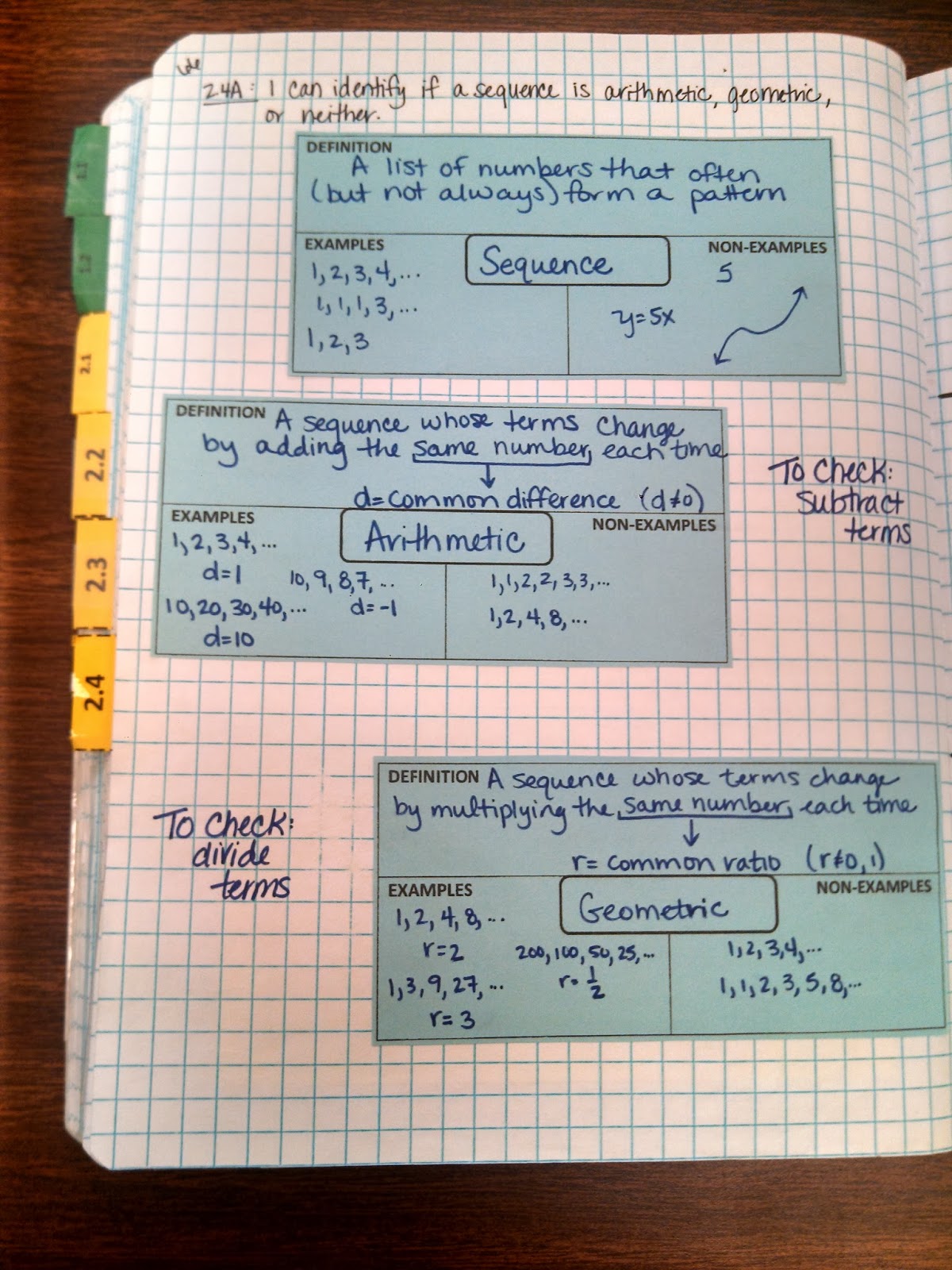
Definitions of sequence, arithmetic, and geometric.  I wanted to be good about including vocabulary, but I still don't think this was enough.  I needed to also show how the words were related to each other, perhaps a graphic organizer was in order...
Definitions
I displayed a bunch of sequences using my projector and had students sort them on the right side of their notebook to practice their understanding of the definitions.  Also to show that it isn't always easy to tell...sometimes they will need to subtract and divide to check.
Sort these
Some students wanted to label this page arithmetic, geometric, and sequence...that was a little concerning and shows that I did indeed need to more emphasize the relationship between the words I was teaching.

Next we discussed writing formulas for the sequences.  Since I had asked about starting point and pattern as we went, I thought recursive was a natural follow.  Instead of using all the nasty notation (a_n, a_1, etc.), I talked with my area education association and someone recommended this now = /next = notation.  

Note:  I liked it a lot, but students wanted to just put the "now" in for the "now" in the second equation so that there would only be one equation.  I think it might have been better to use start = /next = now/.  That might help.
Notes on recursive formulas

To practice I displayed a bunch of sequences and asked students to write the recursive formula for 8 of the 12.
Practice Problems to be displayed
My notebook had the answers :)
Next we looked at writing formulas explicitly.  I tied this into the equations for linear and exponential functions.  We did a mini-breakdown of the equations in class and came up with:
  • Arithmetic:  a = d*n + start
  • Geometric:  a = start*r^n
Those would be very familiar to them and still used a little bit of "sequence notation".

Notes on explicit formulas
We practiced writing explicit formulas the same way we did recursive (even with the same exact sequences).
My notebook :)
My last learning target for this unit is "I can explain why a sequence is a function."  It is perhaps a not-so-great learning target because it is somewhat difficult to teach and assess in a way that requires student thinking and learning.  However, it is very closely aligned to a standard (F.IF.3...?) and I struggle with the battle between whether I should be assessing standards or learning targets.  Anyway those thoughts are best left for a different post.

Here is what we did.  It was an investigation of sorts, where students were to choose a sequence and determine if the table that represented it was a function and if the graph that represented it was a function.  However we had difficulties because my students didn't do super well with determining if something is a function.  

The goal was that students would choose a wide-variety of functions and we could whiteboard individual results, do a gallery walk, and come to the conclusion that all sequences were functions.  However it didn't go down quite like that.  I perhaps needed another day of class, but it was crunch time for semester tests, so I didn't have any wiggle room.  

I ended up having a class discussion, but not assessing that standard.  It is what it is I suppose. 
Sequence = Function (p.1)
Sequence = Function (p. 2)
Notes:
  • I wish I had done more vocabulary up front (ie. term, first term, second term, common difference, common ratio). It is hard for me to remember what words are new to students.
  • Also a graphic organizer to show the relationship between sequence, arithmetic, and geometric.
  • As I said, with recursive formula, I would change the first equation from now = ___ to start = ___.
  • I've really been thinking about how I need to spiral some review in for students.  (More on this later...probably not until this summer.)  I believe this would have helped as we looked at sequences as functions.
Please leave any thoughts or suggestions in the comments, or tweet me (@kathrynfreed).

-Kathryn

Sunday, January 12, 2014

Solving One-Variable Linear Equations

Confession:  I taught an entire semester of Algebra 1 without spending time solving linear equations. 

Why?  Because I knew my students had seen a lot of it in 8th grade, and I also knew that they were all at different places and ready for different challenges.  I also knew that they had forgotten some of what they had learned and a little reminder might take them a lot further.  All of this is hard to address in a class of 20+ students.

However, I knew it was something I needed to address at the start of this semester so that we could solve systems and eventually some quadratics.  I gave a pretest, but it was evident that not a lot was immediately recall-able for them.  So I spent a few days focusing on solving 2-step equations.  Here are a few reasons why I chose to start with 2-step equations:
  • I can say they can all be solved in 2-steps, which helps the students process what they need to do
  • I can address issues like "Ah, there's a fraction!" (but it really just means division) and I can even throw in some parenthesis
  • I can challenge all students with things like -t + 10.2 = -23.1 (the negative variable is really tricky the first few times they see it)
  • It is not out of the reach of most students (I do have a few students who still struggle to solve one-step...but those are students who did not take 8th grade math in my district last year.)
  • It is enough to bring back a lot of what they learned about solving equations
I have one Algebra class that is a little bit quicker than the others, so I got to move away from 2-step equations with them on Friday.  I couldn't decide exactly how to do it, because there are SO MANY ways to solve different equations.  I really just want to ensure they are aware of the various options they have and give them some practice at choosing what to use in what scenarios.  I don't want to say:  "always distribute" or "put the variable terms on the left and the constants on the right" or anything that shows that there is only one way to solve.  I want problem solvers, not procedure followers.

Anyway, here is what I ended up doing.  I just gave them 4 "challenge" equations to solve.  And for the most part, they worked HARD for 30 minutes to work out solutions.  Here are the equations:
  • 2(-1x + 6) = 22
  • 2x + 2 = 32 + 5x
  • 3 - 2x + 6x = 15
  • 5x - 7 = 2(x + 1)
I put the four equations on the board and said "I challenge you to use the resources available in this room to find the solutions (and perhaps a solution method) to these equations today."  We discussed what resources were available and then they got to work.  The review we had done with 2-steps was enough for several students to remember even how to move variable terms to the other side.

There were a few students who "tried" and then gave up and didn't accomplish much at all, but I would say at least 85% of my students worked hard during the time I gave them.  I was SO PROUD of them.  I just wanted to brag a little about my students, because it was everything I hoped it would be.  

We will continue to work with advanced linear equations on Monday and Tuesday to get them more fluent at being aware of the strategies that are available and choosing an appropriate one.  Perhaps with some whiteboarding...

-Kathryn

Thursday, January 9, 2014

Quizlet

I need to get back onto the blogging wagon, and I have been trying unsuccessfully.  So instead of blogging about something thoughtful, I'm just going to share something I learned about at our PD technology day on Monday:  quizlet.com

On this site you can create "sets" of flashcards and study them in many different ways.  Since I've been working at pushing vocabulary in my intervention class, I decided that this would be something to try with them.  Some of the reasons why I decided it was worth trying:  it has a math option for "language" and you can add pictures to the flashcards.  A set can be public, so a set I create my students can use to study.  Also there are apps available for both android and apple devices.

So I created a set for students for this week's vocabulary and had students create an account and join the class to practice for a while today.  We are a google apps school, so I had students use their google account to create a quizlet account.  Then I had them join my class so they could easily access my set, but you can share it by link like this:  Variables and Expressions Set.

What I like is that the students can do several things with the flashcards:

  • use them as flashcards...front - back - front - back - etc
  • "learn"...it gives definition; student types in word
  • "speller"...it says word and gives definition; student types in word
  • "test"...set up a test with x fill-in-the-blank questions, y matching, z multiple choice, and w true-false
  • "scatter"...a matching game where students drag word and definition together; if it matches they disappear
  • "race"...definitions move across the screen and student has to type in the word before it gets across; speed GRADUALLY increases
I think both of the last two will keep a rank of the students and that helps encourage some healthy competition.  I played first so they would try to beat me :)  (However when using the app it doesn't record their scores in comparison to the rest of the class.)

I can think of a lot of things this would be useful for, but you can figure it out too.  So far I'm using the free version, but a better version is available for $15/year or even better for $25/year.  

-Kathryn


Wednesday, December 11, 2013

Exponential Functions

After our Linear Function unit (which you can find here and here), we jumped right into Exponential functions.  
Our beautiful tabs!
Our learning targets
We started by describing exponential functions algebraically, graphically, and numerically.  Here is the foldable we did.  It is very similar to the one we did with linear functions:
Foldable closed
Foldable opened
Then we did a card sort.  We did exponential vs. not exponential.

I asked them to write a reason for why each card was on the side it was on.  Also after our notes on the base and y-intercept, we went back and found the base and y-intercept for each of our exponential functions.

Next we worked on finding the base and the y-intercept.  Notes with a graphic organizer, which is very similar to what we did with linear functions:

I gave them a practice worksheet.  I thought I was really clever and designed it so that they could easily complete, tape in their notebooks, and view later...

...however I then proceeded to copy it upside-down.  :S

Then we graphed exponential functions.  This is where it because crucial to have studied negative exponents prior to this unit.

I had to do another practice worksheet like the one before so that I could prove that I was capable of copying correctly.
Practice WS outside
Practice WS inside
Our last learning target was on writing equations to model exponential situations.  I gave minimal notes that tied to our learning of linear functions (the y-intercept is the start) and the learning we had done with exponential functions.  We had been wondering and noticing that some exponential functions increase and some decrease, but today I FINALLY made it clear what causes that difference.

I did a stations activity with them.  I had a handout for students to use to facilitate the process and our discussion.  Basically I just had students go to nine stations and write the start and the change.  Then we had a class discussion over the equations.  They seemed to think it was pretty easy, which I didn't really expect...I guess I'm just an amazing teacher :)
Handout that they used to go from station to station
NOTE:  To view files click the appropriate link.  It will open in Google drive; it will not show correctly in drive.  Choose to download file.  It will download the word doc/ppt for you with all of the correct formatting.

That's all I have for now.  I don't feel much like reflecting on the unit right now, so I guess this post is finished :)  Sequences are coming up next!  (Well, actually we've started them.  Post to come after the 20th!)

-Kathryn

Sunday, December 8, 2013

Units for Intervention Class

I have been teaching an additional intervention class all year.  This is part of the Tiered Algebra project that our local AEA has been working with schools in our area to implement.  We had been given some guidelines, but not much, for what to do in that time.

  • Connect it to what is happening in the Algebra class
  • Don't just reteach/review what you are doing in Algebra
  • Don't just have "do your Algebra homework" time
  • Do more hands-on stuff
  • Do more explicit instruction
  • Use appropriate scaffolding
  • And others, but that's what I could think of off the top of my head

So here I am, a general Algebra teacher, with very little understanding of how to differentiate in my regular classroom, now seeing 24 of my students twice a day, and doing my very best to make it worthwhile.  But I've been mostly clueless.  I tried to do a lot of pre-intervention with them... (see Micheal Pershan's argument for this type of intervention here) which looked like covering the coordinate plane and plotting points before we graphed linear functions in Algebra, for example.  But I still felt like my students weren't able to use much of what we were doing in a way that truly benefited them in the regular classroom.  Not that I actually had any real way of measuring it...

Then the AEA shared with us about a presentation they heard from a school that has a similar model in 8th grade.  They decided that vocabulary was really important, because IF THEY DON'T KNOW THE VOCABULARY, THEY CANNOT ACCESS THE LEARNING IN THE GENERAL CLASSROOM.  This was an argument I had never heard before.  Now I always knew that vocabulary was important.  And I teach it...sort of, but I've never really emphasized it.  This has changed that.  Along with other things that came from this summary of the presentation, I have changed some things, and I think it is for the better.

I now have week-long units.  These units focus on a particular skill and the vocabulary associated with it.  For example we studied exponents prior to working with exponential functions.  We had vocabulary:  exponent, power, base, exponential, reciprocal, expanded form.  We studied the vocabulary each day in different ways:  matching; create your own example; which could be used for x, which would be used for y; etc.  We also had scaffolded lessons on simplifying exponents.  We started with whole number exponents with only positive numbers.  Then we discussed things such as -2^4 vs. (-2)^4.  We simplified expressions using the order of operations (with exponents).  And finally we saw negative exponents.

I was actually able to see my students apply what we were learning in class (no actual way of measuring other than my observations).  I depended on them to lead the other students when we saw negative exponents.  This felt amazing.  I am excited to continue using this model, although I am very frustrated that it took until November for me to find something this useful for interventions.  Hopefully as I continue to apply it I will see more improvement from these students.

But I am also frustrated by the fact that it is still group all of my intervention students together.  What if student a needs this and student b needs that?  How do I make that work?  How do I know what they need?

Just for an FYI here is an outline of the exponent unit:

-Kathryn

Saturday, November 30, 2013

Math Modeling Contest

On of the math teachers at my school (the one who head's up math club), has been doing a 36-hour Mathematical Contest in Modeling for the past few years.   I am only a helper, but when sharing about the contest, it seemed as though many other were interested in hearing about it, so I decided to share what I know.

The contest is put on by COMAP.  Information about the contest can be found here:  http://www.comap.com/highschool/contests/himcm/index.html.  It is a yearly competition that occurs in November.  It is for groups of  up to 4 students, and costs about $75 per group.  The competition includes a maximum of 36 hours to work on 1 of 2 given real-world problems.  Each group gets to select which problem they would prefer to work on and they work toward a solution.  Then they must write a paper outlining their research, solution, and weakness of it.  Sometimes there are other things they must include, such as a letter or a memo.

I don't think I can share any of the previous problems on here, but they are good modeling problems.  There is not one solution that is obviously the best.  There are many different ways to approach each problem.  Also the problems are low-entry, so even Algebra 1 students can work on them.  Upper-level students can do more sophisticated mathematics with them, but all students can do something to tackle the problems.

Some things we do at Shenandoah:

  • Students register before hand and pay $10-15 to help cover the group fee of $75.  The rest of the cost comes from the math club account, filled by fundraisers.
  • Students may sign up as a group, or individually.  Most students sign up individually, try to convince all their friends to do it too, and then work out groups with the sponsor once our registration is closed.  Teachers have the final say in groups.  We keep most groups all girls or all boys.
  • Each team is assigned a classroom as home base.  Teachers give consent for their classrooms to be used ahead of time, and the students love having control of the room for the weekend.  They can move things around, but by the time they leave it must be back in the shape it was when they arrived.
  • In addition to all necessary classrooms, we use the FCS room for food and the library and the gym as hang out places.
  • We start at 8am on Saturday so that we can be finished by 8pm Sunday.  Of the weekends the contest is available, we try to choose one where few events are happening.  (Also we like it if it is the weekend before Thanksgiving because then we only have to survive a short week afterwards.)
  • Parents sign up to bring meals.  Several sign up together to help feed the kids for each meal that is needed:  lunch and supper on Saturday and breakfast and lunch on Sunday.  Most of the teams are done by supper on Sunday, and for those who aren't there are plenty of leftovers.
  • We encourage teams to make good progress on their projects before lunch on Saturday, but do allow for some brain breaks.  We have the gym and the library open for team co-mingling.
  • Saturday night around 9 we play a game in the gym as a whole group (like line tag) and then watch a movie.  Around 1 or 2 am we have lights out and kids are expected to stay in their sleeping rooms until morning.  Most teams sleep in their classrooms, which is why we usually have all girls or all boys.  If there is a mixed group, then they sleep elsewhere.  Teachers "sleep" in the halls.  We choose locations where kids would have to walk over us to get anywhere if they decided to sneak around.
  • That's all I can think of now.  If you have other questions please, please let me know I'd be happy to help!
-Kathryn

Wednesday, November 27, 2013

Negative Exponents by Patterns

Right in between our unit on linear functions and our unit on exponential functions, I did a little "review" of zero and negative exponents.  I tried to teach it strictly by patterns.  Last year I taught the rules and then explained via the patterns why the rules were there.

I start with what students know.  I ask students to evaluate 3^1, 3^2, 3^3, and 3^4.  They can do this and they can even show why it works.  We recorded that part in this table (sorry all I have pictured is the final, but imagine half of it is blank :)


We notice that the the pattern from 3 to 9 to 27 to 81 is times 3 (duh!), but still important to state.  Then I ask students to think about the pattern backwards... Divided by 3!  So we continue that pattern to see 3 divided by 3 is 1 :)  And we have to continue the pattern on the top showing that 3^0 is 1. So then we talk about how multiplying 0 threes (or 0 anythings is 1).  It's still hard for them, but they can see.  I try to draw the connection to 0 in addition  (the identity) and 1 in multiplication (the identity).  But they are freshmen, so that is advanced.  If a few students make that connection from our quick discussion I'm happy.

Then we continue dividing.  1 divided by 3 is 1/3 (yes I have to force them to use fractions--I just say that they will recognize the pattern better if they use fractions).  Then by 1/9 there is a bunch of "oh"s and almost every students (or at least every students who is still paying attention) can say that the next in the pattern is 1/27.

We use the word reciprocal (instead of opposite as they tend to) and come to the rule that to evaluate negative exponents, we evaluate the positive first.  At this point I gave them several problems to practice in their notebooks.

That about sums it up.  If you have other questions about this, let me know :)  Or other ideas to make it better I'd be happy to hear it!!!!

-Kathryn